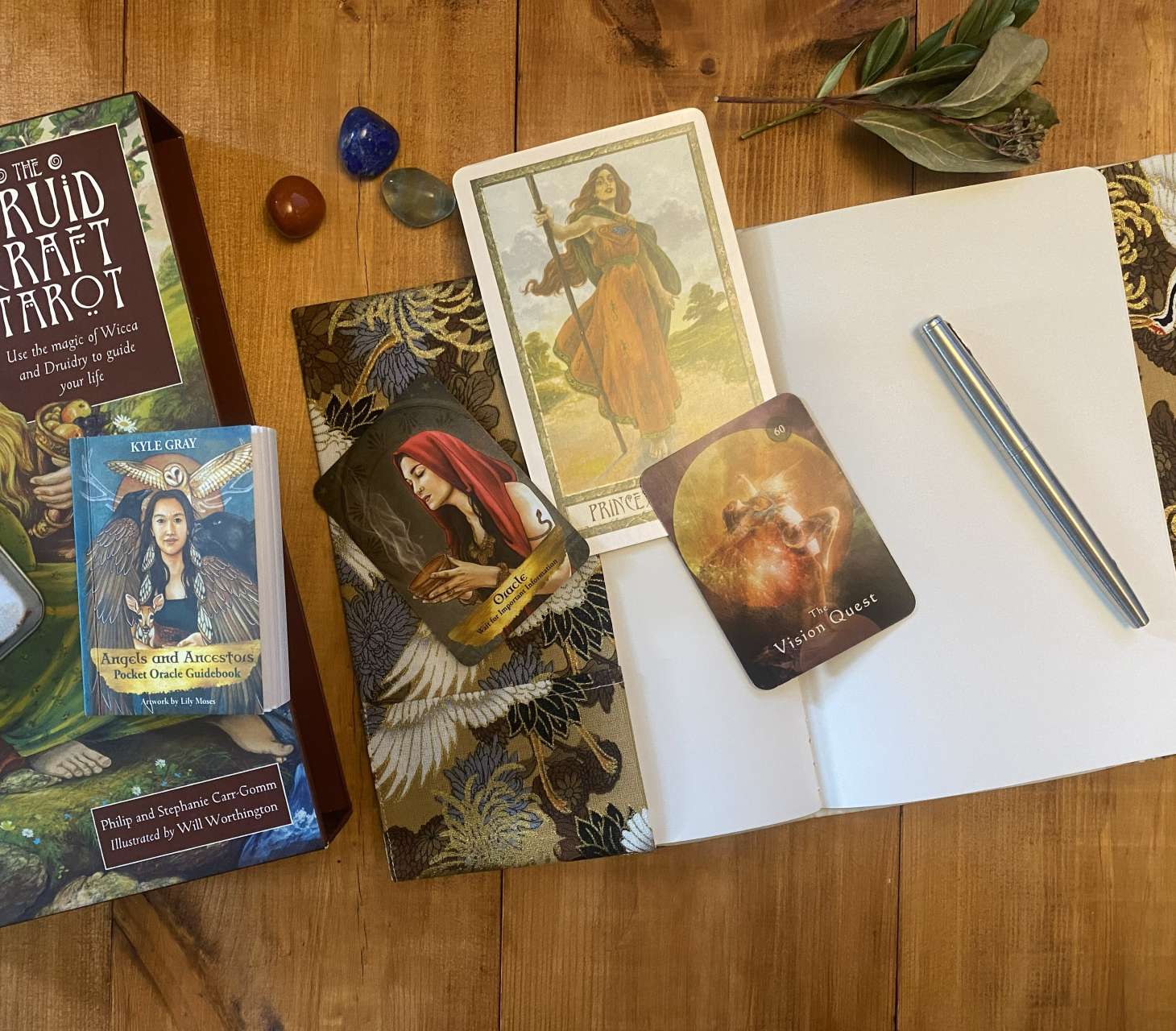
In a busy, noisy, and often overwhelming world, it’s easy to lose sight of your own internal compass. So much attention is pulled outward — to expectations, responsibilities, opinions, information — that your own thinking can begin to feel crowded out. Many people look for ways to make sense of themselves more clearly, and there are plenty of structured tools designed to help with that. Personality systems such as the Myers-Briggs Type Indicator, StrengthsFinder and the Enneagram offer useful frameworks for describing behaviour, motivation and habitual tendencies. They give us language to describe ourselves and a structure for recognising patterns we might not otherwise notice.
But ultimately, those systems work from the outside in. Although they are self-reporting tools, they still summarise who we are using categories defined by someone else.
Tarot and oracle cards work differently.
When you draw a card, you are not being labelled. You are noticing your own response to what you see. You are asking, “What does this stir in me?”
Over time, that process strengthens something quieter and more stable inside you. You begin to recognise yourself in different archetypes, not as a fixed identity but as a shifting mix of strengths, blind spots, reactions and choices. Used in this way, tarot and oracle aren’t really about predicting what will happen next. They are structured tools for reflection — a way of stepping out of mental noise and into a deeper, steadier awareness of who you are and what feels true.
For some people, that awareness is simply clarity. For others, it feels more spiritual — a reconnection with something deeper than surface-level thinking. However you understand it, the direction is the same: inward.
What Is Tarot?
Tarot is a deck of 78 cards divided into two main parts: the Major Arcana and the Minor Arcana. While the structure remains consistent across decks, the imagery and tone can vary widely. Some decks feel light and expansive in colour and atmosphere; others are darker, more symbolic or more grounded. The framework stays the same, but the mood shifts.
The Major Arcana consists of 22 cards, numbered from 0 to 21. These cards tend to reflect broader life themes and turning points — moments of growth, disruption, responsibility, loss, renewal or integration. They often feel weightier, not because they predict dramatic events, but because they speak to patterns that shape direction and identity over time.
The Minor Arcana contains 56 cards and reflects the texture of day-to-day life. It is divided into four suits, each associated with a different aspect of human experience: Cups with emotion and relationships; Wands with energy, creativity and direction; Swords with thought, communication and decision; Pentacles with work, resources and the practical world.
Within each suit, the numbered cards suggest development or movement through a situation — early stages, growth, tension, completion — while the court cards (Page, Knight, Queen and King) often represent ways of responding, personality traits or different expressions of maturity.
Taken together, these layers create a system that is rich enough to explore almost any scenario, because it mirrors so many familiar human themes. It does not contain answers in advance. It contains symbols that invite interpretation.
A Brief History of Tarot
Playing cards originated in Asia and made their way to Europe during the late medieval period. Tarot emerged in 15th-century Europe as a card game, played for entertainment rather than insight. Only later, particularly during the 18th and 19th centuries, did tarot become associated with symbolic and esoteric interpretation.
By the early 20th century, decks such as the Rider–Waite Tarot placed detailed imagery on every card, making interpretation more visually layered and accessible. Over time, tarot gradually moved beyond fortune-telling contexts and into creative, reflective and personal development work.
Today, it is used in journaling, coaching, development circles and individual contemplation. The shift has been gradual but significant — from trying to predict events to exploring perspective and meaning.
What Are Oracle Cards?
Oracle cards developed more loosely alongside tarot and do not follow a single fixed structure. There is no standard number of cards, no division into Major and Minor Arcana, and no consistent symbolic framework shared across all decks. Instead, each oracle deck reflects the vision of its creator.
Some focus on emotional insight, others on nature, mythology, affirmation or spiritual themes. Some are visually intricate; others are simple and text-based. Because there is no system to memorise, oracle cards can feel more direct. A single card may contain one word or short phrase that acts as a prompt for reflection.
Used alongside tarot, oracle cards often provide emphasis or tone. Tarot builds a layered picture; oracle distils a theme. For beginners, oracle cards can also offer an accessible entry point into this way of working, without removing the possibility of depth.
Using Tarot for Self-Reflection
Creating a Structure for the Question
When tarot is used for reflection rather than prediction, the structure matters. A spread — the arrangement of cards into specific positions — creates a framework for thinking. Each position represents an aspect of your situation. For example: what is visible, what is hidden, what may be influencing you, what you can control, what may need to be accepted, or what direction feels possible.
The structure gives the reading its shape, and the imagery adds depth to it.
As the cards are laid out, meaning begins to form in context. A card drawn in a “challenge” position will feel different from the same card drawn as “strength.” A Major Arcana card appearing among Minor cards may suggest that what you are facing carries broader implications than you first thought. The cards are not isolated statements. They are part of an interconnected pattern.
Testing Meaning in Real Life
You do not simply apply a definition and move on. Instead, you test what you see against your own experience.
As you look at a card in a particular position, you might ask yourself: Does this feel accurate? Where does this show up in my life? Is there something here I recognise immediately — or something I resist? That reaction is part of the reading.
Imagine you bring a work situation that feels persistently unsatisfying. At first, you may describe it in practical terms: workload, management style, lack of recognition. A spread might explore visible challenges, underlying influences, long-term direction and internal attitudes.
As the cards unfold, something else may begin to surface. Perhaps a card reflecting creativity or independence appears in a position connected to long-term aspiration. Another card reflects hesitation or self-doubt. Gradually, you may begin to notice that beneath the practical frustration with your job, there’s a deeper longing — something you have wanted to pursue for years but have kept postponing.
Maybe you realise you dismiss the idea before you even explore it. Maybe you notice you’ve been waiting for permission that no one is ever going to grant.
The cards do not announce this. They create space for you to see it.
Noticing What Holds You Back
Once that longing is acknowledged, the reflection widens.
You might begin to ask: What has stopped me? Is it fear of instability? A belief that it is too late? A sense that it would be irresponsible? Have I internalised expectations about success that don’t actually belong to me?
A further spread allows these strands to be separated gently. One card may reflect the longing itself. Another may highlight the thinking that restricts it. Another may suggest small, practical steps — not dramatic leaps — that would allow you to give that part of yourself a little more space.
You are not being pushed toward upheaval. You are being invited to look more honestly at what is already there.
A Structured Conversation
In this sense, tarot becomes a structured conversation — not only between you and the cards, but between different parts of yourself.
As a reader, my role is not to deliver answers. It is to offer interpretations and perspectives that you can reflect on and respond to. You remain free to accept, reshape or discard what does not feel right. Often the most important moment in a reading is when you say, “Yes — that’s exactly it,” or, “No, that’s not quite it, but this is.”
That clarity is something you find for yourself.
Reflection as Spiritual Practice
For some people, this reflective process is simply about clearer thinking. For others, it becomes something more spiritual. Working with symbols can feel like stepping out of the constant activity of the analytical mind and into a quieter awareness — one that feels connected to intuition, deeper values, or a sense of meaning that is difficult to articulate logically.
You do not have to define that connection in religious terms. But many people experience tarot as a way of remembering that they are more than their thoughts and more than their circumstances. In that sense, it can become part of a spiritual practice — a routine way of reconnecting with something steadier beneath daily noise.
How to Start Using Tarot and Oracle Cards for Yourself
If you are beginning, it helps to start with one deck that you feel drawn to rather than collecting several at once. Consistency builds familiarity. If possible, look through decks in person so you can hold the deck and get a feel for the imagery and tone. If choosing online, take the time to view sample cards and notice which style feels clear and engaging.
When you receive your deck, resist the urge to jump straight into complex readings. Spend time simply looking. Separate the Major and Minor Arcana. Lay out the suits and compare them. Notice how the Two of Cups differs in feeling from the Two of Swords. Pay attention to your impressions before consulting a guidebook.
Later, you can deepen your understanding by learning traditional meanings. Your personal interpretation and established symbolism can then work together.
Begin with simple spreads — three cards are enough. ‘Past, present and future’, or ‘situation, challenge and next step’ provide structure without complication. With oracle cards, you might draw a single card as a weekly point of reflection and return to it over the week rather than pulling repeatedly.
As the cards become more familiar, reflect on your own experiences. Which cards would you choose to describe particular periods of your life? Which archetypes feel familiar? Find the cards that tell the story of your life. Over time, the symbolism becomes lived rather than abstract.
How I Use Tarot and Oracle in My Work
In my work, tarot and oracle are used as reflective tools rather than predictive devices. If you come to me feeling stuck, uncertain or overwhelmed, I will ask for context about what is happening so that the spread can genuinely explore your situation. You might share that you are struggling with a relationship, questioning a career move, or wrestling with a long-standing decision.
- In a Video Reading, the spread is then shaped to look at visible challenges, underlying influences, strengths you may not be recognising and possible directions. The aim is not to produce a yes-or-no answer, but to open the situation out so that you can see it more clearly — and perhaps from a perspective you had not considered.
- In Monthly Tarot & Oracle Boards, the focus is lighter but still intentional. Rather than exploring one specific question in more depth, you receive themes and points of attention for the month ahead — reminders to return to as you move through the month – steady points of reflection if you begin to doubt yourself or feel pulled off course.
- In a one-to-one Life Reflection Session, the cards are introduced within conversation. You might join our meeting feeling mentally tangled or emotionally uncertain. At certain points, a card may be drawn to shift perspective or illuminate something that has not yet been spoken. The conversation remains central. The cards serve the conversation — not the other way around.
Throughout all of this, the cards are not positioned as authority. They do not fix problems or override your judgement. They offer structure and symbolism through which your situation can be examined more clearly. The decisions that follow remain yours.
FAQs
Is tarot predictive?
Tarot can be used predictively, but many people use it as a reflective and even spiritual tool. It offers themes and perspectives to consider rather than fixed outcomes.
Do you need to be psychic to read tarot?
No. Tarot is a symbolic system. You learn to interpret images and themes in relation to your own experience and intuition.
Is tarot linked to a particular religion?
Tarot is not tied to one religion. Some people use it within a spiritual framework; others approach it psychologically or creatively.
How often should you draw a card?
There is no set rule. Some people draw a card weekly as part of a reflective or spiritual routine. Others use the cards when facing a specific question.
What if a card feels negative?
Cards reflect the full range of human experience. A challenging card is not a prediction of failure; it may highlight something that needs attention.
Can you read tarot for yourself?
Yes. Many people begin by reading for themselves. Familiarity and confidence grow gradually through practice.
Exploring Further with Calm in a Crazy World
If this way of working feels relevant to you, you can explore it further in a few different ways:
- Tarot & Oracle Sessions offer a structured space to look at a specific question or situation in your life.
- Relax & Realign gives you guided relaxation practices to help you settle and reconnect with yourself.
- The Change Series invites you to reflect on patterns in your thinking and make intentional shifts over time.
- Peace for Health supports you in preparing calmly for medical or surgical procedures.
Read more here, or get in touch if you’d like to ask a question.